Using the new Fields of Research (FOR) subject categories available in Altmetric (via data supplied by Dimensions), and CWTS’ VOSviewer, it’s possible to visualize disciplinary differences as a network. That network can help communicate how the broader impact that books have varies by discipline. It can also potentially support comparative understanding of a collection of books.
In the diagram below, clusters of books form around different sources of broader impact. Blog and news mentions are closely related, and they form an important central point in the graph. Policy mentions are most associated with Education, Economics, Environmental Sciences and other Humanities. Wikipedia mentions are well-balanced across the disciplines, while patents are particularly important in Biological Science, Chemical Sciences, Engineering, Computing, and Technology.
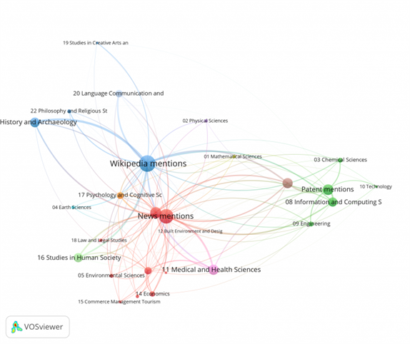
Network visualizations and analyses can produce compelling evidence of publishing catalogs. They provide benchmarks against which a list’s potential for broader impact can be evaluated. For example, a publisher of Arts and Humanities monographs might reasonably expect to see Wikipedia attention, and rather fewer patent citations.
Monographs from different subject areas attract attention from different sources. VOSviewer creates clusters of similar data, identified by color and position. Strength of relationship is shown by thickness of line. Relative strength of activity is shown by the size of the type and circle. For example, we see that Chemical Sciences, Information and Computing Science, Technology, and Engineering cluster around Patents. VOSviewer suggests that news and blogs (the red circle, slightly overlapping with the News circle) are tightly related for books. Policy documents are represented by the red circle between Environmental Sciences, Economics, and Medical and Health Sciences.
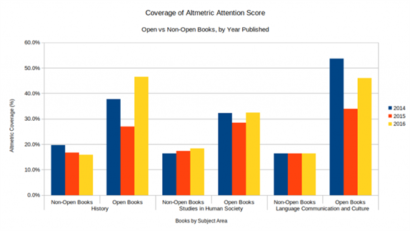
Evidence also suggests that there is a marked advantage for open access (OA) monographs over traditional, toll access books, with Altmetric coverage being significantly higher for OA monographs in some disciplines.
It’s important to note that this observation is across a relatively small set of books, and Altmetric is undertaking further analysis. Initial findings were presented at the LATmetrics event in Peru in early November, with a paper soon to follow. If you’re interested in studying this topic or other themes related to altmetrics for monographs, Altmetric also provides free data access options for researchers.
To ensure the future success of books within the scholarly environment, it’s necessary to understand their unique contribution to scholarship, as well as the distinctive ways in which they achieve impact.
It has been long established that books are generally slow to accrue citations – with the implication that short periods of evaluation are inappropriate for books (and monographs in particular). Similarly, Altmetric data has been shown to accrue more slowly for books than research articles, however that impact – when it does accrue – appears to be at a higher rate than articles, and possibly over a long period of time. Institutions, funders and evaluation professionals should be mindful of the long-term value of books, notably when it comes supporting their future funding, development and assessment.
We are at the beginning of understanding the data that allows this deeper understanding of book impact and look forward to supporting book publishers and academics for home books are their key output, especially those in the humanities, social sciences and arts.
Disclaimer: This is to inform readers that the views, thoughts, and opinions expressed in the article belong solely to the author, and do not reflect the views of Amnet.
Copyright © 2020 Amnet. All rights reserved. No part of this publication may be reproduced, distributed, or transmitted in any form or by any means, including photocopying, recording, or other electronic or mechanical methods, without the prior written permission of the publisher, except in the case of brief quotations embodied in critical reviews and certain other non-commercial uses permitted by copyright law. For permission requests, write to John Purcell, Executive Editor- Amnet, addressed “Attention: Permissions” and email it to: [email protected]